


I make no apologies for liking concrete. Although we generally only get to work on ‘crapcrete’ (I’m not complaining, it’s given me a career), some buildings illustrate what can be achieved, but thankfully for the sustainability of my business, only rarely so.
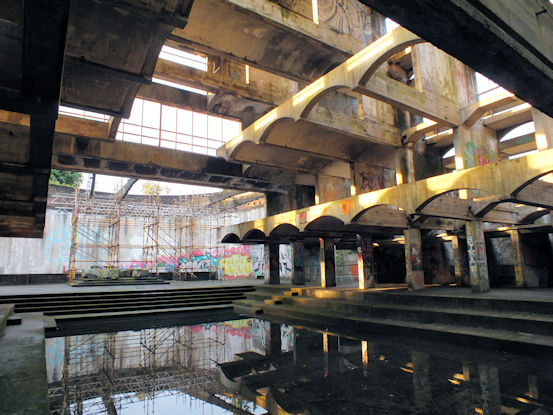 The various buildings, and their parts, illustrated here are in the West of Scotland, built in the early 1960’s but abandoned in the late 1980’s when the site became a focus for vandals who, together with the ravages of time and exposure, reduced them to ruins, reclaimed by the forest.
The buildings are now category A protected, including some of the graffiti on the walls, and on the World Monument Fund’s watch list of the 100 most endangered buildings.
CRL Surveys, variously working for consultants and architects were initially involved in 2007, undertaking some limited testing on the derelict and overgrown site, including assessments of concrete material condition and assessments of the pre-cast, exposed aggregate cladding panel fixing details. We were subsequently asked, on the cleared site, to undertake more extensive testing, with trial removals of at least some of the poorer quality (profane and obscene) graffiti.
Certainly not to everyone’s taste, but occasionally we have the pleasure of working on something special, and regardless of the who’s, whys and what fors, we can take pride in the albeit small part we play in helping try to save buildings, in my opinion, worthy of saving.
 The Main buildings with pre-cast panels are perhaps not of particular merit, we come across many similar buildings, they just look incongruous in their setting here. However, the now exposed, in-situ, board-marked framework of the Main Building indicate the detail with which the buildings were both designed AND constructed. Considering the dereliction, the in-situ concrete is almost pristine, with the board-marking, a repeating feature in other areas, revealing thought, care and attention to the finish. The external elevations of one building are particularly impressive, having been cast with inset panels of board-marked in-situ concrete, with the board-marking criss-crossed. This detail is made even more pleasing by the deviation it forces on surface water run-off and the resultant staining / patina. Standing in front of it brings a tear to the eye. This building also includes an amazing, large, concrete staircase, which springs up and down from a central pair of columns, without touching either the floors above or below.
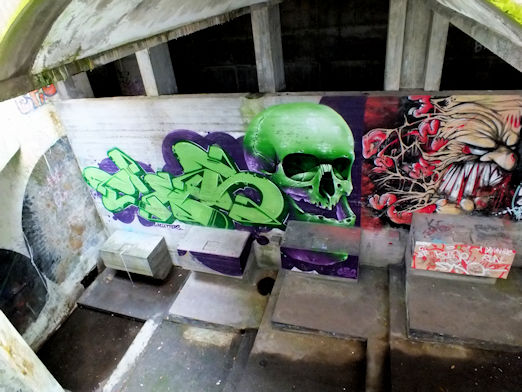
Again, not to everyone’s taste, but the graffiti, at least in some locations, is spectacular and has taken time and effort to craft.
 Contact